The Delight in Giving Massage: Inhabiting the Place Beneath the Hands
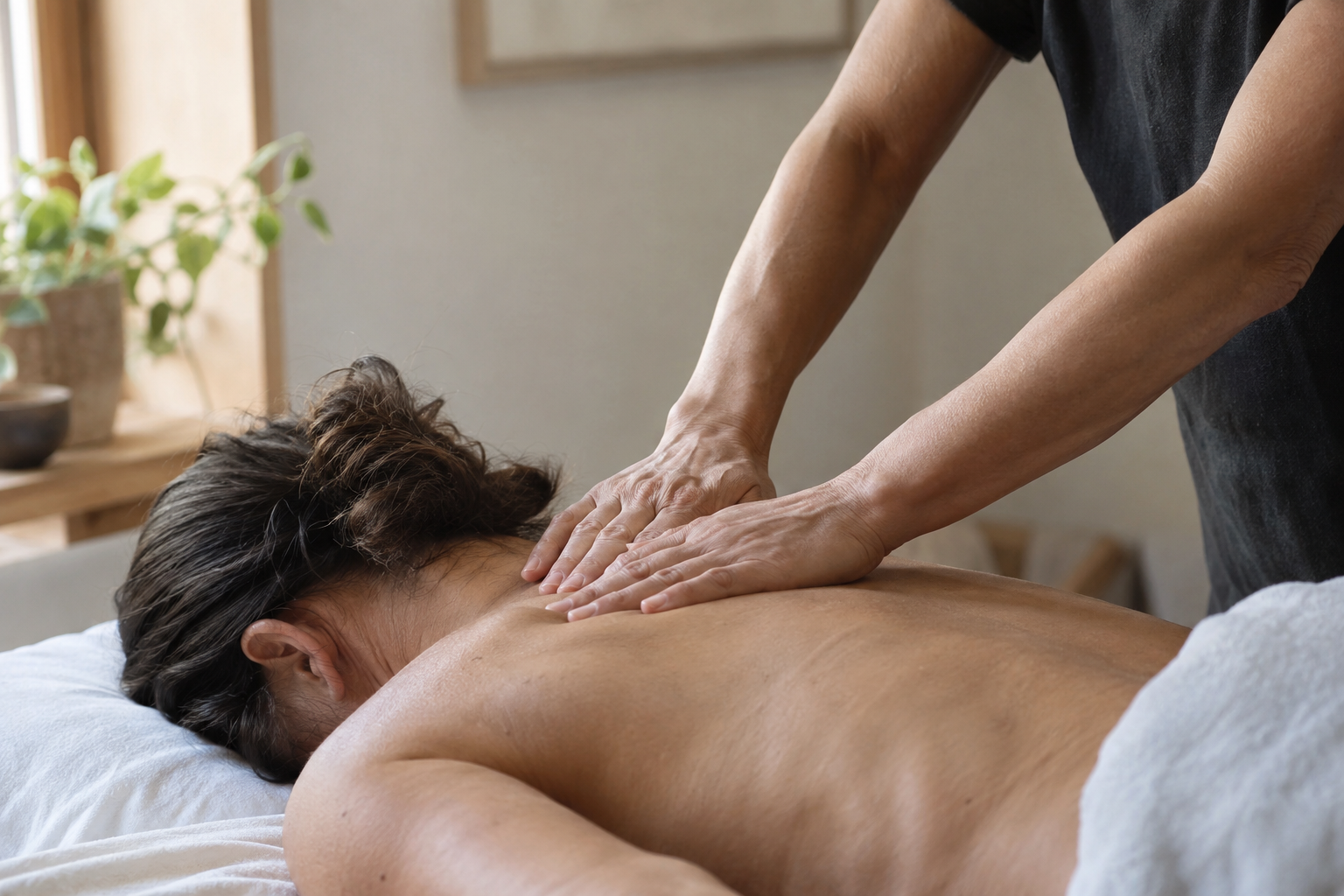
As massage therapists, we know that giving massage is often pleasant, not simply because it helps someone, but because the act itself generates a steady stream of satisfying moments. The pleasure is immediate. It unfolds inside the session, quietly and continuously, and is so ordinary that we barely notice it, let alone name it.
Touch produces a series of small satisfactions in the giver. The hands meet resistance and yield. They register subtle changes—softening, guarding, receptivity. But the pleasure does not live in the fingers themselves; it is not simply about what the hands feel on the outside.
What matters is what those sensations evoke. The contact generates something inward, a felt response that arises in the giver. The hands gather information, but that information does not remain tactile. It becomes experiential. It becomes lived.
As I work, I find myself forming a kind of internal image, though “image” is not quite the right word. It is more like a felt simulation—a kind of vicarious experience of the touch I’m giving. When my fingers make contact with a salient place that makes me want to linger, I am not only aware of its shape or texture. I am aware of what it might feel like to be there—to inhabit that sensation from the inside, to carry it, to have pressure arrive and linger and slowly alter it. The experience unfolds within me, not in the tissue itself.
This imagining happens without effort. I do not decide to do it. It arises on its own. Sensation and empathy merge so seamlessly that it is difficult to tell where one ends and the other begins.
The experience isn’t static. It changes moment by moment. As what I feel beneath my hands changes, the imagined sensation shifts with it. Attention is held effortlessly, not by force but by interest.
In this way, giving massage can feel almost as lovely as receiving it. Sometimes it feels nearly identical. Sometimes it may even feel better, as if the imagined version of relief is smoother than real sensation ever is. Each moment gives way naturally to the next.
This may help explain why some massages are more pleasant to give than others. Some bodies offer more information. There are shifts in resistance, movement, response. They provide a rich stream of sensation that invites this inward inhabiting. Other bodies are quieter. They offer less variation and less change. There is nothing wrong with this, but the experience for the therapist is different. With less to imagine, there may be less opportunity for that kind of inner experience to arise.
What strikes me is how rare this kind of experience is in human work. Very few professions involve sustained, attentive contact that continuously generates an internal, embodied simulation of another person’s sensations. Most work keeps attention outward, on objects or outcomes, or turns it inward, toward one’s own effort and performance. Massage occupies a middle ground, where attention rests partly inside oneself while being shaped by another body.
Perhaps this is why the experience goes unnamed. It does not fit neatly into existing categories: not technical skill, not emotional labor, not sympathy, not quite imagination in the usual sense. It is something quieter and more immediate.
I suspect many massage therapists already know this, even if they have never put words to it. The pleasure of giving massage is not incidental. It is woven into the act itself. Sometimes all it takes is noticing it.
Deepen your understanding at your own pace. Access a full library of neuroscience-backed courses for less than $1 a day.
Author
Dr. Mark Olson holds an M.A. in Education and a Ph.D. in Neuroscience from the University of Illinois, specializing in Cognitive and Behavioral Neuropsychology and Neuroanatomy. His research focused on memory, attention, eye movements, and aesthetic preferences. Dr. Olson is also a NARM® practitioner, aquatic therapist, and published author on chronic pain and trauma-informed care. He offers a variety of courses at Dr-Olson.com that provide neuroscientific insights into the human experience and relational skill training for professionals and curious laypersons.