The Sleep Test: What Massage Reveals About How Touch Actually Works
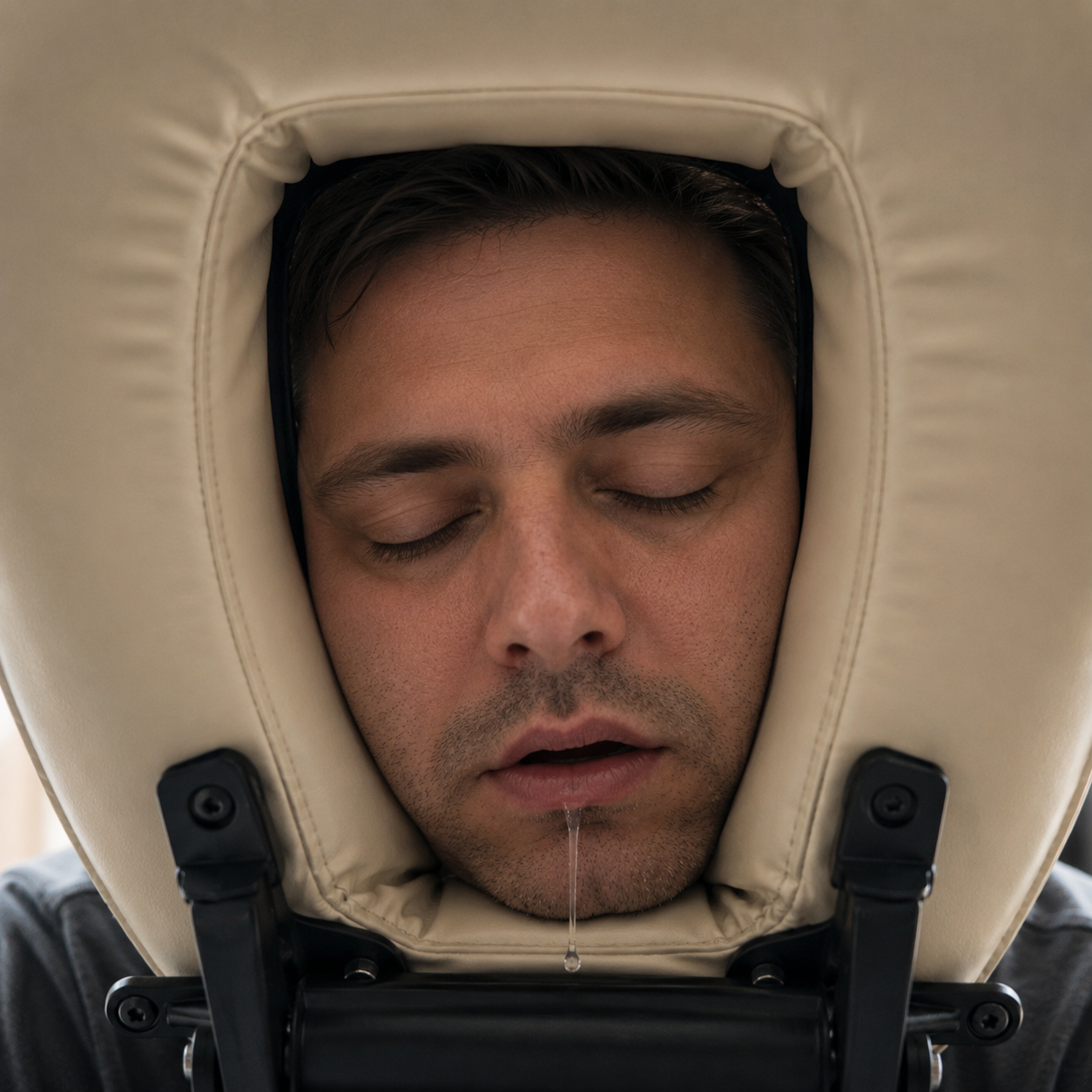
It happens regularly in massage therapy practices: a client falls asleep mid-session. They wake apologetic, worried they've wasted the treatment. But have they?
In one sense, they haven't wasted anything at all: if someone falls asleep during massage, it's often because they desperately needed rest, and that rest itself is valuable. But setting that aside for a moment, there's another question worth asking: does massage work if you're asleep? And if so, what parts work, and what parts don't?
A note before going further: This isn't a review of research on massage during sleep; there isn't enough research to answer these questions directly. It's a thought experiment, based on my current understanding of pain, touch, and the nervous system, along with my experience as a massage therapist. Some of what follows is reasonably well established, some is inference, and some is speculation. The point isn't to provide a definitive answer, but to use sleep as a way of thinking more carefully about what massage might actually be doing.
Why does this matter? If massage worked primarily through tissue changes or purely reflexive mechanisms, consciousness wouldn't matter. If it worked only through cognitive mechanisms, sleep would wipe out the benefit entirely. Neither seems quite right, and that gap says something about pain, the nervous system, and how the body responds to touch.
Consider an analogy: If you fell asleep during a concert, you'd know you missed something. Not just the music, but the experience of being moved by it, the memory of what it felt like to be there. That much seems obvious. But it's also true that playing music while someone sleeps can affect them—their nervous system still processes sound, their physiology still responds to it. So even sleeping through a concert isn't necessarily a complete loss. This same tension exists with massage.
Consider your own experience: does massage feel the same whether you're fully present for it or drifting in and out of sleep? Most people intuitively sense a difference, even if they can't articulate what it is.
What Persists Without Awareness
Some processes involved in massage don't require you to be awake. Your nervous system continues processing touch even during sleep, just differently.
Some reflexive responses operate at the spinal cord level, below conscious awareness. When pressure and stretch change sensory input from muscles and connective tissue, the spinal cord processes some of these signals automatically through local circuits. Changes in muscle tone, autonomic activity, and nociceptive signaling can occur whether you're conscious or not.
Touch may also modulate nociceptive signaling through sensory interactions that don't require conscious participation. Whatever the precise contribution of these mechanisms during massage, the sleeping nervous system hasn't stopped responding to touch.
What Requires Participation
But something essential vanishes when consciousness does: the experience of massage, not just the sensory input but what it feels like to receive it, requires you to be awake.
Descending modulation (the brain's top-down influence on nociceptive processing) continues during sleep, but without the same conscious engagement. Nociceptive signals can still reach the brain during sleep—they can wake us, after all—but conscious appraisal is different or absent. Your assessment of safety, your expectations and beliefs about the massage session, and your conscious sense of agency and therapeutic alliance depend, at least in substantial part, on awareness.
The meaning we make of touch, the sense of being cared for, the relief of being attended to: all or most of this disappears during sleep. And these aren't necessarily trivial add-ons to massage; they may be central to its value, particularly for people living with persistent pain.
Something else is at play too: the embodied resonance between therapist and client, the experience of being in physical dialogue with another person, of having your body responded to and attended to in real time. This isn't just social touch in the abstract; it's a particular kind of resonant, relational experience that you don't get from other professionals, and certainly not from self-care. Sleep eliminates the conscious experience of this dimension.
Compare massage from a robot to massage while asleep. Imagine a conscious client receiving massage from a sophisticated robot, and a sleeping client receiving massage from a skilled human. The robot preserves the client's conscious experience but lacks the full social-relational dimension of human touch and, at least currently, the refined responsiveness to haptic feedback that characterizes skilled human touch. The sleeping client has a human providing adaptive, responsive touch but lacks the conscious experience of being in dialogue with them.
We don't know which would be more beneficial, and that's part of what makes the comparison useful. It separates several things we usually experience simultaneously during massage: sensory input, skilled responsiveness, conscious experience, and human relationship. Thinking about what remains when one of those elements disappears helps show how difficult it is to reduce massage to any single mechanism.
Social touch raises a related question. One might assume that it only matters when someone is consciously aware of being touched by another person—that the relational dimension requires conscious recognition. But affective touch is processed through neural systems that don't necessarily depend entirely on conscious appraisal. C-tactile afferents, for example, respond preferentially to certain kinds of slow, gentle touch and contribute to affective aspects of touch processing.
Do these systems function meaningfully during sleep? We don't know with certainty, but it's plausible that some affective processing continues without conscious awareness. Lighter stages of sleep may also permit more sensory processing than deeper stages, so the answer may vary depending on what kind of sleep is occurring.
Still, the experienced social dimension of touch clearly changes. You can't consciously experience being cared for if you're not aware you're being cared for, even if your nervous system continues processing aspects of the touch.
What This Reveals About Mechanism
The sleep scenario suggests massage isn't purely biomechanical (if it were, you'd presumably get essentially the same benefit while asleep), but it isn't purely cognitive or psychological either, since sensory and physiological processes clearly continue without awareness. It operates at multiple levels at once.
Broadly, these processes fall into three categories.
Some clearly don't require consciousness: sensory transmission, spinal processing, and various automatic physiological responses.
Others may continue during sleep but in altered form: higher-level sensory processing, affective-touch processing, autonomic regulation, and descending modulation.
And then there are experiences that inherently require awareness: consciously evaluating a sensation, exercising agency, experiencing another person's touch as caring or reassuring, remembering what the experience felt like, and potentially incorporating that experience into how you understand your body.
Sleep doesn't simply turn massage “off.” It changes which of these dimensions are available.
This has practical implications. If someone falls asleep during massage, they're likely still experiencing sensory and physiological effects. But they're missing at least some of the experiential dimension: the conscious experience of receiving therapeutic touch and integrating that experience.
Different aspects of massage may matter more for different goals. For immediate comfort, relaxation, and physiological responses to touch, consciousness may be less critical. For experiences that depend on meaning, agency, memory, and one's relationship with bodily sensation, consciousness likely plays a much larger role.
Discover how the intricate relationship between the brain, pain, and body shapes our experience of posture. This on-demand course unpacks neuroscientific insights and connects it to practical bodywork techniques, empowering professionals and individuals to approach pain and posture with confidence and clarity.
What You Take With You
This raises a secondary question: which benefits last longer after the session, the ones that operate automatically or the ones requiring consciousness?
The reflexive effects might feel more immediate but could be shorter-lived. Changes in muscle tone, autonomic activity, and spinal-level modulation may dissipate relatively quickly once the stimulus is removed. They're largely real-time responses to ongoing input.
The conscious components might persist longer precisely because they involve memory and lived experience. You're not just experiencing temporary neurophysiological changes; you're remembering what it feels like to be comfortable in your body, feeling embodied and present rather than disconnected from sensation, perhaps reducing the catastrophic sense that you can never be out of pain. These experiences could influence how you move, what you attempt, and how you interpret sensations after the session ends.
Value doesn't always depend on lasting effects, though. Some experiences nourish you in the moment without claiming to create permanent change. A good meal, a concert, time spent with someone you care about: these matter even when their effects are temporary. The experience of receiving caring touch, of feeling embodied resonance with another person, of having an hour where your body feels attended to and safe—this has worth independent of whether it “lasts.” Sleep eliminates access to much of this experiential dimension of massage.
This is speculative, and the reality likely depends on individual circumstances. But it's worth considering that conscious, experiential components of massage may contribute to more durable changes, while some automatic responses to touch may provide more immediate and transient effects.
Beyond the Binary
The question “does massage work if you're asleep?” assumes a binary answer. But massage works through multiple processes operating at different neurological and experiential levels, some requiring consciousness and others not. Sleep doesn't cancel massage: it gives us a way to think about which parts are automatic, which depend on awareness, and which occupy the uncertain territory between the two.
Massage, then, appears to operate neither entirely below awareness nor through conscious participation alone, but through an interaction among sensory input, neurophysiology, conscious appraisal, and human relationship. You can get some of it while sleeping. But you can't get all of it.
Missing a concert while asleep isn't just missing the music. It's missing the memory of having been moved by it, the felt sense of what that experience was like. Similarly, sleeping through massage might mean missing not just the sensations, but the integration of those sensations into your sense of what your body can feel like.
Recognizing the difference helps us think more clearly about what therapeutic touch actually does.
Author
Dr. Mark Olson holds an M.A. in Education and a Ph.D. in Neuroscience from the University of Illinois, specializing in Cognitive and Behavioral Neuropsychology and Neuroanatomy. His research focused on memory, attention, eye movements, and aesthetic preferences. Dr. Olson is also a NARM® practitioner, aquatic therapist, and published author on chronic pain and trauma-informed care. He offers a variety of courses at Dr-Olson.com that provide neuroscientific insights into the human experience and relational skill training for professionals and curious laypersons.